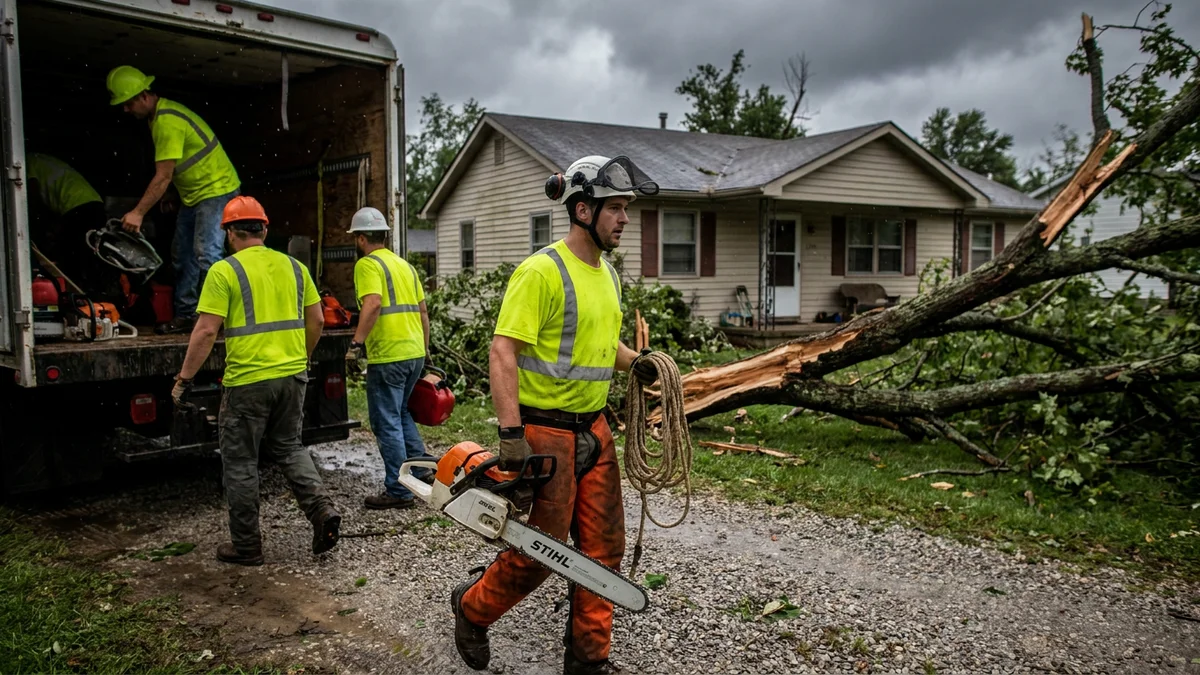
When a storm comes through, every tree company in the area gets flooded with calls at once. The companies that come out ahead that week aren't necessarily the ones with the most trucks. They're the ones who pick up the phone fastest and triage correctly. The ones who don't lose real money, not just a few missed calls.
Why isn't response time just one number?
Emergency tree services typically advertise 24/7 response with arrival times around 60 minutes for the most urgent situations, a tree on a structure or an immediate safety hazard. In practice, actual response is tiered: most urgent residential calls get reached within one to three hours, while non-critical calls may wait several hours or even a day or two during a major weather event. That tiering isn't a failure, it's necessary. A responsible storm response system triages calls the same way every time: life-safety situations and downed power lines go to 911 and the utility company first, trees on structures go to the on-call crew immediately, and everything else books into the cleanup queue in order. The problem isn't having a queue. The problem is when the intake process itself is slow, so calls sit unanswered before they even reach the triage step.
The response-time and margin ranges in this article reflect patterns documented across storm dispatch playbooks and emergency tree service guides, not a guarantee for your specific market. Local competition, storm severity, and how many companies serve your area all shift the real numbers.
How real is the storm-work premium?
Storm and emergency dispatch work typically earns a real premium over standard rates, generally in the 20 to 50 percent range for straightforward jobs, and 2x to 3x standard rate once you factor in crane work, trees on structures, or night response, according to ArboStar's emergency tree removal pricing guide. Margins on efficiently deployed emergency crews commonly run 25 to 40 percent, well above a typical scheduled removal.
The standard-rate multiple storm and emergency tree work commands once crane work, structural damage, or night response is involved — a premium that only exists while the storm is still fresh.
That premium only exists while the storm is fresh news and the homeowner hasn't already called three other companies. A day later, the same job often gets rebid at standard rates because the panic has passed and homeowners have time to shop. Every hour of delay on the first call isn't just a delay, it's a shrinking window on a job that was worth meaningfully more an hour earlier.
Where do the hours actually go?
This is the part most owners underestimate. The average multi-crew tree service loses 5 to 10 billable hours a week to double-bookings, forgotten callbacks, weather cancellations, and idle crews waiting between jobs, according to ArborDash's storm response playbook, even in a normal week. During storm season, that number gets worse, not better, because call volume spikes faster than most companies can staff their phones.
Run a simple example. Say a storm event generates 60 calls in 48 hours for a two-crew operation. If intake response averages even 90 minutes per call because no one dedicated is answering it, a meaningful share of those homeowners will have already booked with whoever called back first, often within 15 to 20 minutes. If even a third of those 60 calls go to a faster competitor, and the average storm cleanup job runs $800 to $2,500 depending on tree size and access, that's tens of thousands of dollars in a single weekend that never even became a missed-call statistic. It just became someone else's job.
How should you staff the phone during a spike?
Most multi-crew operations handle storm intake one of two ways. The first is rotating it among whoever isn't currently on a job, which means the person answering is sometimes a climber standing in a customer's yard, distracted, checking a second phone between cuts. The second is designating one person, even temporarily, whose only job during the spike is answering, logging, and triaging calls, while the crews stay focused on the trees already in front of them. The math almost always favors the second option. A dedicated intake person answering in a few minutes converts a meaningfully higher share of calls than a rotating system averaging 60 to 90 minutes, even though the dedicated person isn't billable themselves. Missing that trade-off is one of the more common ways storm-week revenue quietly disappears, because it never shows up as a missed call. It shows up as a job that went to someone else before your crew even heard about it.
Does staffing the phone during a spike actually pay for itself?
Say a storm hits and you pull in temporary phone coverage for the week, someone whose only job is answering and logging every incoming call, at a rough $20 an hour for 40 hours. That's an $800 investment. If dedicated coverage recovers even one extra job that would otherwise have gone to a faster competitor, and the average storm cleanup runs $800 to $2,500 depending on tree size and access, that hire has already paid for itself. Anything beyond one recovered job, in a week where 60 or more calls are coming in, is close to pure margin. The math rarely favors leaving the phone to whoever happens to be between jobs.
Does the backlog end when the storm does?
The spike gets the attention, but a real share of storm-generated work doesn't get scheduled until days or weeks later, once an insurance adjuster has been out and a homeowner has a claim number to work from. Those jobs are just as real as the ones called in during the first 48 hours, but they're easy to lose track of if the only system for storm intake is a notepad by the phone or a stack of sticky notes on a dashboard. A homeowner who was told "we'll follow up once your claim clears" and then never hears from anyone again calls the next name on their adjuster's contractor list instead of waiting on you.
What should you track if you want your real number?
If you want to know whether storm season is actually costing you the way this article describes, three numbers matter more than gut feel:
- Time from first ring to a human answering or a callback going out, not just voicemail.
- The share of storm-week calls that never get a same-day response of any kind.
- How many of those never-answered calls you can trace to a competitor's truck showing up instead.
Most companies can pull the first two from a call log in an afternoon. The third takes asking a homeowner directly when a lead goes cold, which is uncomfortable, but it's usually the number that makes the case for fixing intake stick.
What actually fixes this?
The fix isn't more trucks. It's making sure every incoming call during a spike gets acknowledged immediately, even if the actual crew dispatch has to wait its turn in the triage queue. A homeowner who gets a fast callback confirming "you're on our list, here's roughly when we'll reach you" rarely keeps shopping. A homeowner who gets voicemail three times in a row calls the next name on the list. This is exactly the gap Closer Growth exists to close for tree service companies. Tree service leads come to you exclusively, never shared with three other companies competing for the same storm-damaged yard, so you're not racing a clock that's already run out before you even see the lead. No retainer contract, no-shows replaced free, and a 3-day trial to prove the model works before you commit to anything longer.
What's your average time from an incoming storm call to first contact right now? If you don't know, that's the number worth finding before the next storm rolls through.
Sources: ArboStar, Emergency Tree Removal Cost & Staffing Guide; ArborDash, Storm Response Playbook for Tree Service Companies; Bellafsm, Tree Service Storm Response Dispatch Playbook.
Ready to fill your pipeline?
Start with a low-cost 3-day trial. Exclusive homeowner leads delivered to your pipeline before you commit to a plan.
Book your strategy call